


A missing tooth can affect chewing, speech and your general sense of wellbeing. Many people therefore wonder what options are available for closing a gap in their teeth. Dental implants are one of them.
But what exactly is an implant? How does the treatment work? What conditions need to be met? In this article we answer the most common questions about dental implants – clearly and without complicated technical jargon. Your dentists Katja Michaelis and Dr Michaelis have both successfully completed the comprehensive curriculum-based training programme in implantology at Cologne University Hospital and are members of the BDIZ, the German Association of Implantologists in Europe (European Association of Dental Implantologists).
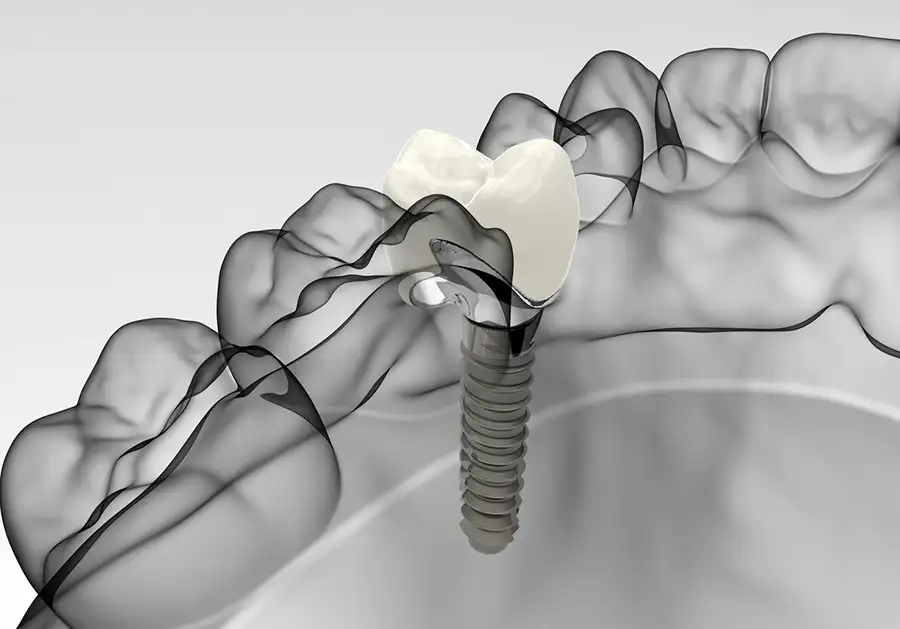
A dental implant is an artificial tooth root that is placed in the jawbone. It is usually made of titanium or ceramic and forms the basis for the dental restoration that follows. A crown, a bridge or – depending on the situation – a denture can then be attached to the implant.
Once placed, the implant needs time to fuse firmly with the jawbone. Only then is the final restoration fitted.
Implants can be an option whe
Whether an implant is the suitable or best solution always depends on your individual situation. Key factors include the health of your gums and jawbone, your general health and your personal preferences.
The treatment takes place in several stages.
To begin with, the dentist examines your teeth, your gums and your jaw. X-rays or three-dimensional imaging help to plan the treatment carefully.
The implant is placed in the jaw under local anaesthetic. As a rule, no pain is to be expected during the procedure.
Over the following weeks or months, the implant bonds with the jawbone. How long this process takes varies from person to person.
Once healing has been successful, the custom-made restoration is attached to the implant.
Many patients feel apprehensive ahead of the procedure. Thanks to the local anaesthetic, placing the implant is generally painless during treatment. Afterwards, temporary swelling or discomfort may occur; this is usually mild and subsides after a few days. Your practice team will be happy to tell you what to look out for in the first few days.
Compared with other treatment options, implants can offer various advantages – depending on your individual situation.
These include, for example
Which advantages are actually relevant in your case is best discussed in a personal consultation.
An implant requires careful oral hygiene.
This includes:
Good care helps to keep teeth, gums and implants healthy in the long term.
Yes. Not every gap has to be treated with an implant. Depending on your individual situation, bridges or removable dentures, for example, may also be suitable solutions.
Which treatment suits you best can only be assessed after a thorough examination.
There is no blanket answer. Longevity depends on factors including oral hygiene, regular check-ups and individual health considerations. An implant can potentially last for many years.
Not always. Whether implant treatment is possible is assessed as part of a detailed examination.
That depends on your individual starting point. There is often a healing phase of several weeks to months between placing the implant and fitting the final restoration.
Cover depends on the type of insurance and on the individual treatment. Your practice will give you transparent information about the expected treatment and cost plan before treatment begins.
Dental implants are often a good and well-established way of replacing missing teeth. However, whether they are suitable for you can only be assessed after a personal examination.
If you have questions about dental implants or would like a no-obligation consultation, please feel free to book an appointment at our practice. Together we will discuss your individual situation and explain the various treatment options clearly and transparently.