


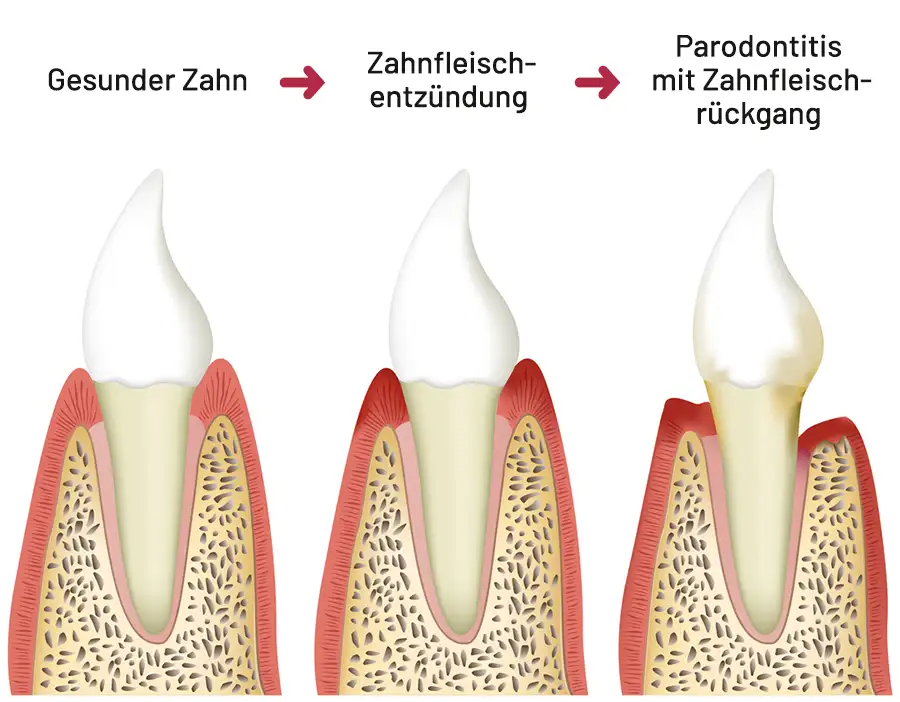
Periodontitis is a chronic inflammation of the periodontium – the tooth-supporting apparatus. It therefore affects not only the gums but also the structures that anchor the tooth in the jaw. Left untreated, the condition can lead to progressive loss of tooth-supporting tissue and, ultimately, to tooth loss. At the same time, periodontitis can today be well controlled with a systematic, individually tailored treatment concept.
It usually begins with the bacterial biofilm, i.e. dental plaque. If this is not removed sufficiently, the gums can become inflamed. Typical signs are redness, swelling or bleeding gums.
In some people, this develops into periodontitis. Here the immune system responds to the bacterial load with an inflammatory reaction that can damage the periodontium. So-called periodontal pockets form, in which bacterial deposits and tartar become increasingly difficult to remove yourself.
How quickly and how severely the disease progresses varies from person to person. Alongside oral hygiene, factors including smoking, certain general health conditions and other individual risk factors play a role. A careful examination is therefore the basis of every periodontitis treatment.
Modern periodontal therapy does not begin with a single measure, but with a comprehensive assessment and individual treatment planning.
An important component is improving oral hygiene at home. Patients are shown how to remove plaque as effectively as possible and which aids are suitable for their personal situation.
Bacterial deposits and hard deposits are then professionally removed above and – where necessary – below the gum line. Depending on the findings, further treatment steps may be necessary. For this, the European S3 guideline recommends a stepwise approach guided by the individual clinical picture and the treatment outcome.
After the active treatment, we check how the gums and the periodontium have responded to the therapy. Only this repeat assessment shows whether further measures are needed.
A crucial component of periodontal therapy is supportive periodontal therapy (SPT).
Periodontitis is a chronic disease. The aim of aftercare is therefore not to reach a particular state on a one-off basis, but to stabilise the oral health achieved over the long term. At SPT appointments, the gums and periodontium are checked, home oral hygiene is reviewed and, where needed, deposits are professionally removed, among other things. The intervals between appointments are set individually according to the severity of the disease and personal risk.
Regular aftercare is therefore not an 'add-on' to periodontitis treatment. It is an essential part of the treatment concept.
Even better than treating a condition that has already developed is to identify risks early and, as far as possible, to prevent inflammation from arising in the first place.
This is precisely where prophylaxis comes in. Regular check-ups, oral hygiene tailored to the individual and professional support can help to detect changes early and maintain oral health over the long term.
At Zahnarztpraxis Nordstraße, prophylaxis has therefore held a special place for decades. Our long-established prophylaxis concept combines regular professional support with individual guidance on daily oral hygiene.
Treating periodontitis requires experience, careful diagnostics and a willingness to adapt one's own treatment to the current state of scientific knowledge.
At Zahnarztpraxis Nordstraße, Katja Michaelis, Julian Schwartzkopff and Dr Sebastian Michaelis bring many years of experience from both university and practice, along with extensive professional training. This knowledge feeds into the individual assessment and care of each patient.
The focus is not on a single treatment method, but on a long-term approach: detecting conditions as early as possible, taking existing risk factors into account, planning treatment in a clear and transparent way, and maintaining the oral health achieved through consistent aftercare.
Periodontitis does not have to be viewed with fear. What matters is good diagnostics, individually tailored treatment and consistent aftercare.
And it is even better when prophylaxis helps to detect conditions as early as possible, or to prevent them from developing at all.
Healthy teeth need not only good treatment but, above all, long-term care.
Your Zahnarztpraxis Nordstraße – professionally dedicated, personally here for you.